Sıçanlarda laminektomi sonrası oluşan epidural fibrozisi önlemede nintedanibin etkinliğini araştırma
Ozgur Ocal1, Abdurrahim Tas2, Zuhal Yildirim3, Ayse Cakir Gundogdu4, Ozge Selahi5, Abdurrahman Aycan21Sağlık Bilimleri Üniversitesi, Ankara Şehir Hastanesi, Beyin Cerrahisi Kliniği, Ankara-Türkiye2Van Yüzüncü Yıl Üniversitesi Tıp Fakültesi Nöroşirürji Anabilim Dalı, Van, Türkiye
3Etimesgut Halk Sağlığı Laboratuvarı, Ankara, Türkiye
4Kütahya Sağlık Bilimleri Üniversitesi Tıp Fakültesi Histoloji ve Embriyoloji Anabilim Dalı, Kütahya-Türkiye
5Kırıkkale Yüksek İhtisas Hastanesi Beyin Cerrahi Kliniği, Kütahya-Türkiye
AMAÇ: Nintedanibin topikal ve sistemik uygulanmasının, bir sıçan modelinde post-laminektomi epidural fibrozis gelişimi üzerindeki etkisini araştırmak. GEREÇ VE YÖNTEM: Otuz iki sıçan, dört eşit gruba ayrıldı. L1–L2 laminektomi, standart mikrocerrahi tekniği kullanılarak gerçekleştirildi. Kontrol grubuna yalnızca laminektomi yapıldı; steril salin grubuna laminektomi sonrası steril salin ile yıkama yapıldı; topikal nintedanib grubuna laminektomi sonrası topikal nintedanib uygulandı; sistemik nintedanib grubuna laminektomi sonrası oral nintedanib verildi.
BULGULAR: Kontrol grubundaki iki sıçanda 2. derece ve altı sıçanda 3. derece epidural fibrozis gelişti. Steril salin grubundaki fibrozis seviyesi kont-rol grubuna benzerdi. Topikal nintedanib grubunda üç, dört ve bir sıçan sırasıyla 1., 2. ve 3. derece epidural fibrozis geliştirdi. Sistemik nintedanib grubunda beş sıçanda 1. derece ve üç sıçanda 2. derece epidural fibrozis gözlemlendi. Plazma matriks metalloproteinaz-9 (MMP-9), interlökin-6 (IL-6), vasküler endotelyal büyüme faktörü (VEGF), transformasyon büyüme faktörü beta-1 (TGF-β1), tümör nekroz faktörü-alfa (TNF-α) ve hidroksiprolin (HYP) seviyeleri grup 3 ve grup 4'te, grup 1 ve grup 2 ile karşılaştırıldığında önemli ölçüde daha düşüktü (p<0.05). Çalışma gruplarında plazma miyeloperoksidaz (MPO) aktivitelerinin nintedanib tedavisinden sonra değişmediği gösterilmiştir (p>0.05).
SONUÇ: Mevcut çalışmada histolojik ve biyokimyasal sonuçlar, nintedanibin post-laminektomi epidural fibrozisin tedavisi için potansiyel bir farmakolojik ajan olduğunu göstermektedir. Doz etkinliğini belirlemek için geniş popülasyon üzerinde ve aralıklı değerlendirme yapılan çalışmalara ihtiyaç vardır.
Anahtar Kelimeler: Epidural fibrozis, nintedanib, inflamasyon, hidroksiprolin, miyeloperoksidaz
Examining the effectiveness of nintedanib in preventing post-laminectomy epidural fibrosis in rats
Ozgur Ocal1, Abdurrahim Tas2, Zuhal Yildirim3, Ayse Cakir Gundogdu4, Ozge Selahi5, Abdurrahman Aycan21Clinic of Neurosurgery, University of Health Sciences, Ankara City Hospital, Ankara-Türkiye2Department of Neurosurgery, Van Yuzuncu Yil University Faculty of Medicine, Van, Türkiye
3Etimesgut Public Health Laboratory, Ankara-Türkiye
4Department of Histology and Embryology, Kütahya Health Sciences University, Faculty of Medicine, Kütahya-Türkiye
5Department of Neurosurgery, Kırıkkale High Speciality Hospital, Kütahya-Türkiye
BACKGROUND: In this rat model study, we examined the effects of topical and systemic nintedanib treatment on the development of post-laminectomy epidural fibrosis.
METHODS: Thirty-two rats were divided into four equal groups (n=8 per group). An L1–L2 laminectomy was performed using standard microsurgical procedures. The control group underwent laminectomy only; the sterile saline group underwent laminectomy followed by sterile saline irrigation; the topical nintedanib group underwent laminectomy followed by topical nintedanib application; and the systemic nintedanib group underwent laminectomy followed by oral nintedanib administration. The degree of fibrosis was evaluated by histological examination. Plasma levels of matrix metalloproteinase-9 (MMP-9), interleukin-6 (IL-6), vascular endothelial growth factor (VEGF), transforming growth factor beta-1 (TGF-β1), tumor necrosis factor-alpha (TNF-α), hydroxyproline (HYP), and myeloperoxidase (MPO) were compared among the groups.
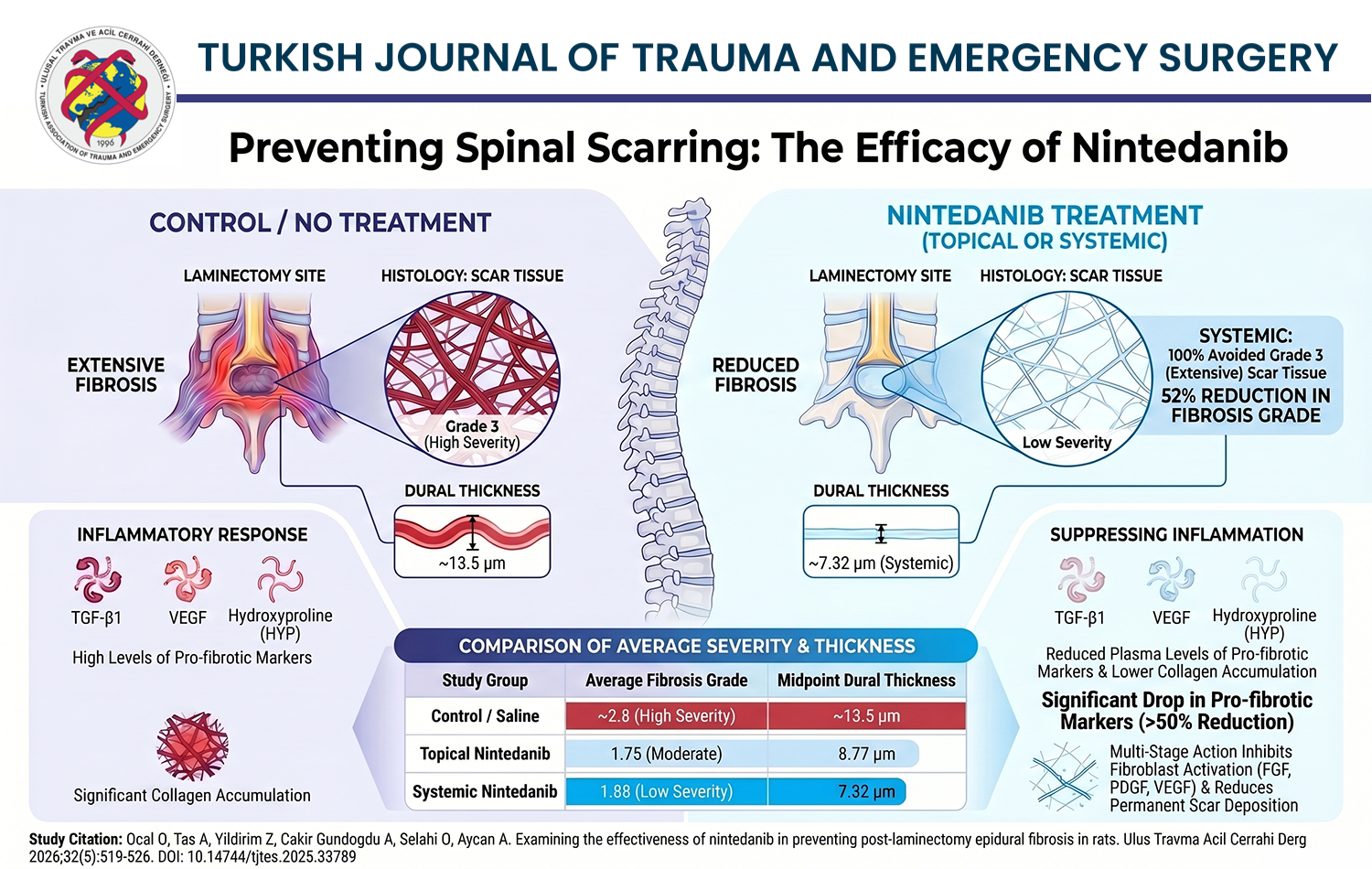
RESULTS: In the control group, two rats developed grade 2 epidural fibrosis, while six animals developed grade 3 fibrosis. The sterile saline group demonstrated a similar degree of fibrosis to the control group. In the topical nintedanib group, three, four, and one rat developed grade 1, grade 2, and grade 3 epidural fibrosis, respectively. In the systemic nintedanib group, five rats had grade 1 epidural fibrosis, whereas three rats had grade 2 fibrosis. Groups 3 and 4 showed significantly decreased plasma levels of MMP-9, IL-6, VEGF, TGF-β1, TNF-α, and HYP compared to Groups 1 and 2 (p<0.05). Plasma levels of these markers were lower in Group 4 than in Group 3; however, the difference was not statistically significant (p>0.05). Plasma MPO activity in the study groups was not altered following nintedanib treatment (p>0.05).
CONCLUSION: The histological and biochemical findings of the present study indicate that nintedanib is a promising pharmacological agent for the prevention of post-laminectomy epidural fibrosis. Further studies with larger sample sizes and interval assessments are needed to clarify the effects of different dosages.
Keywords: Epidural fibrosis, nintedanib, inflammation, hydroxyproline, myeloperoxidase
Grafiksel özet
Makale Dili: İngilizce